You’ve got a vision. You find a creative partner whose work you love. You totally vibe on the kickoff call. You can’t wait to see the result. You wait with baited breath for what you’re sure will be everything you could ever imagine.
Meanwhile, your project clock is ticking. You’re working on media buys, content scheduling, etc., confident that you’ll just have to drop in those stunning visuals once they arrive.
The email comes, and it feels like your birthday came early. You unwrap that present you’re sure contains just what you asked for (aka, you open the attachment), and… they are just not it.
Now not only are you disappointed, your whole project timeline and budget might be off track.
What went wrong? You could probably blame the creative team, the internet connection, the trends or the phase of the moon. Honestly, though, the design is probably perfectly fine. It’s just not what you wanted. And when reality doesn’t meet expectations, well, nobody wins. But even the world’s greatest designer can’t meet an expectation they don’t understand.
So how do you head off creative disconnect and help your partners absolutely nail your vision? It all starts with a killer brief. Basically, the more we (your creative partners) know, the happier you will be. Set clear expectations, and designers can really flex their creative skills within those boundaries.
It’s not just about us, either. Putting a brief together gives you a chance to think through your vision and get on the same page with any other stakeholders. In this guide, we’ll cover the who, what, when, why and how of nailing the creative brief for delightful design.

What is a creative brief?
Think of it as your project bible—a single source of truth for what is going into any creative project.
A creative brief is a written summary of any project involving multiple people. It’s where you distill a big idea into a clear outline, covering the vision, use-case, expectations, timeline, branding, inspiration and content, so everyone understands what you’re doing, why you’re doing it and what it should look like when you get there.
Why write a creative brief?
Probably because you are contracting out specific elements of a campaign or project. Maybe it’s a new logo design, brand refresh, annual report, seasonal campaign or standalone asset. Whatever the project, a brief is the foundation of your agency or freelancer’s marching orders.
But that’s not all! Creative briefs are helpful for in-house projects, too. Whether you are putting in a cross-department request or just need a roadmap for your team’s big idea of the moment, a brief is a great way to build consensus and make it happen in an efficient, timely manner.
A few more reasons to write a creative brief:
- Avoid scope-creep
- Stay on-task and on-schedule
- Clarify your vision
- Define success
- Get great results
When do you write a creative brief?
Short answer: early on, but be prepared to revise.
Creative brief writing comes after strategic planning but before work officially kicks off.
A note on strategic planning: Nothing happens in a vacuum. Each tactic should fit within a larger strategy, so try not to jump ahead to the details of any one creative asset. Not sure where to start? We can help.
When you’re ready to tackle the individual projects, book a brainstorming sesh with your team to get everyone’s idea and vision out on the table. The creative brief is a distillation of that big-picture, fun, messy chat, and an opportunity to build consensus internally before sharing it externally.
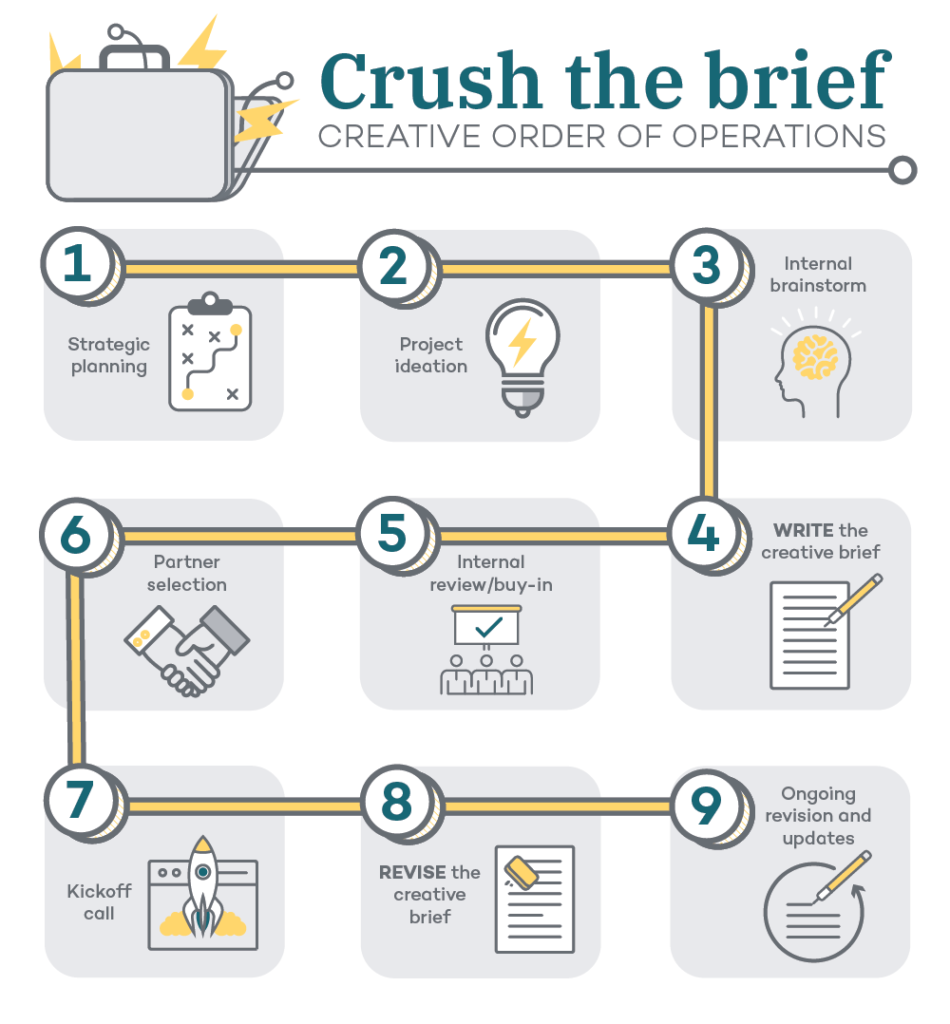
Once you’ve selected your agency for freelancer and gotten internal buy-in, you’ll write the brief itself. But you’re not done once it’s written! This is a starting point intended to be a living document throughout the project.
Your creative brief will inform your big project kickoff call with whoever is going to be executing your vision. If you’ve put in the work internally, your kickoff call with your contractors will be that much more productive. It gives the creatives a chance to ask questions and build their understanding of your brand and your project vision. AND, it’s YOUR chance to ask them: what do you want to see on a creative brief? Everyone creates differently. Beyond the standard elements, some creators might have specific questions or items that really help them, and there might be info that’s really important to some that others don’t want to be bothered with.
So be prepared to take another pass at your brief once your partners have had a chance to weigh in. Then keep it handy! Pull it up for every project check-in, and update it regularly to reflect changes in scope or timeline.
Who writes the creative brief?
Probably the marketing manager or project point person. On small teams where everyone is wearing many hats, this could change.
The important thing is to decide who is owning this part of the process. The last thing you want is to leave that internal brainstorm without any next steps or documentation of where you landed as a team.
How do you write a creative brief?
Omg we are so glad you asked. Start with your vision and drill down from there. While every brief will probably look a bit different, there are some major elements that you should always include.
Project title
Sounds simple. But you’d be surprised how many different names people will come up with for the same thing. (Maybe you wouldn’t be surprised if you have a dog. You know how those irresistible nicknames just creep right in. One day he’s Roscoe, the next he’s your sweet little pupperuffagus. Cute, but chaotic.)
Name the project here. It’s like etching the title onto a dog tag. So even if team members are throwing around wacky titles all willy-nilly, you know what’s real.
Concept
What are we doing here? What’s the big idea? Give us the elevator pitch. If you can’t share it in a few lines, you’ve got some work to do.
Use-case
How are you going to be using this asset? The design approach will be very different for a bus ad than a banner, for example. If you’re looking for a backdrop, help us out by telling us where it’ll be going. Will it sit behind your table at your next trade show, or alongside a red carpet for photo ops?
Timeline
Simple but key. List your start dates, draft and review deadlines and projected publication or release date here. For multi-channel campaigns, include dates for when you need to get art to the printer, advertising outlet, web developer for posting, social media team for scheduling, etc.
Audience
In 10 words or less, tell us who this campaign is for. Feel free to link to any more detailed audience analyses or personas you’ve got. We always love to see that context. But for the purposes of this brief, we need to be able to understand at a glance who we are talking to.
Objectives
What does success look like? What action do we want the audience to take? What do we hope happens as a result of this project or campaign?
If we don’t define success, anything can feel like failure.
Vision

Tell us about the look and feel you’re going for. Is it smooth and classy? Sweet and fun? Inspiring or sarcastic?
Share your inspiration here. But also expiration, which might not be a word, but what I think of as anything we should know that you hate. Share examples of what to do and what not to do. These can be from your own brand or others.
Go wild with a mood board, share a few links or go all in with insights on what works and what doesn’t.
Deliverables
Here’s where we get down to nuts and bolts.
Lay out exactly what your creative partner is expected to deliver. For an ad campaign, that might include a list of designed ads in specified file formats and sizes. For an email campaign, it would probably be a collection of graphics including a header, infographic, and three to five images.
Please specify dimensions!
Brand assets
Share it all! Include your brand guide, logos, typography, color palette, brand voice, key messages–whatever you’ve got, as long as it is current and accurate.
Include any marketing assets here, too, that your designer might find useful.
Content
What is actually going into this project?
If you are handing the whole project off for complete creative development by an integrated team (like YellowDog), you can probably skip this part. If you are already inside that integrated team, or you’re working on a shoestring and are only contracting for design, this is where you lay out what is actually going into each asset (including approved copy).
Link or share any specific image files here, with any notes you may have about their use or placement. Don’t have notes? That’s fine, too. Trust your design team to run with what you give them. The idea is to share all the thoughts you do have so no one is surprised down the road.
Wild cards
Here’s where we stop being polite and start getting real. Kind of. Please continue to be nice to your creative partners. But at this point in the creative brief, we’ve all gotten to know each other enough to drop the pretense. Share your big wild thoughts or brand quirks that you think would help us nail the vision.
Does a certain song play in your head when you envision the final project? What would the perfect scene smell like? If your brand was a cloud, what kind of cloud would it be? You get the picture.
Answer the questions you’re asked
Now that you’ve covered the basics, make sure you’re providing the info your actual creative partner needs. They may ask you to complete a questionnaire or worksheet, and that info should not be discounted. The more you follow their system and speak in each others’ languages, the better.
Remember, this is a starting point! Don’t stress if you don’t have all these pieces. That’s what we are here to help with.
Don’t cry because it’s over
We already went over the importance of keeping your brief handy as a live document throughout the project. Once the project is out in the world, though, it’s time to debrief.
Look back at your objectives and metrics of success. Record what worked, what didn’t and what you learned along the way. Reconvene the original internal team to share your insights. Did the final product reflect the initial vision? Did the audience take action? Were there specific elements or iterations that worked better than others?
Ideally, you end up with a comprehensive overview that anyone can look back at down the road to repeat or apply these lessons for the next time.
Remember, this is all just a starting point! Every project is different. Talk to your team members, make it your own, and improve as you go.
Ready to make it your own? We made you a designer-approved fillable template to absolutely crush the creative brief every time.